When Should You Start the Recruiting Process?
The short answer: earlier than you think
“When should we start?” is the question we hear most from athletes and parents. The honest answer: about three to four years before you plan to start college. That doesn’t mean emailing coaches at 14. It means knowing what’s ahead, so every year builds on the last.
This guide is for any athlete hoping to compete in college, whether you’re a high schooler in Texas or finishing prep school in Virginia. It walks you through what to focus on at each stage, what to do if you’re planning a gap year, and how to catch up if you’re starting late.
Why timing matters
College coaches build their rosters one to three years in advance. By the time most athletes start thinking about college in their final year of school, many roster spots and much of the scholarship budget are already promised.
Starting early gives you three advantages:
More options. You can consider every level, from NCAA Division I to NAIA and junior college, rather than only the programs that still have room.
Better grades on record. Academic results count from your first year, and strong grades unlock academic money on top of athletic aid.
Time to improve. Coaches like to follow an athlete’s progress. Two seasons of results and video tell a much stronger story than one.
Your recruiting timeline, stage by stage
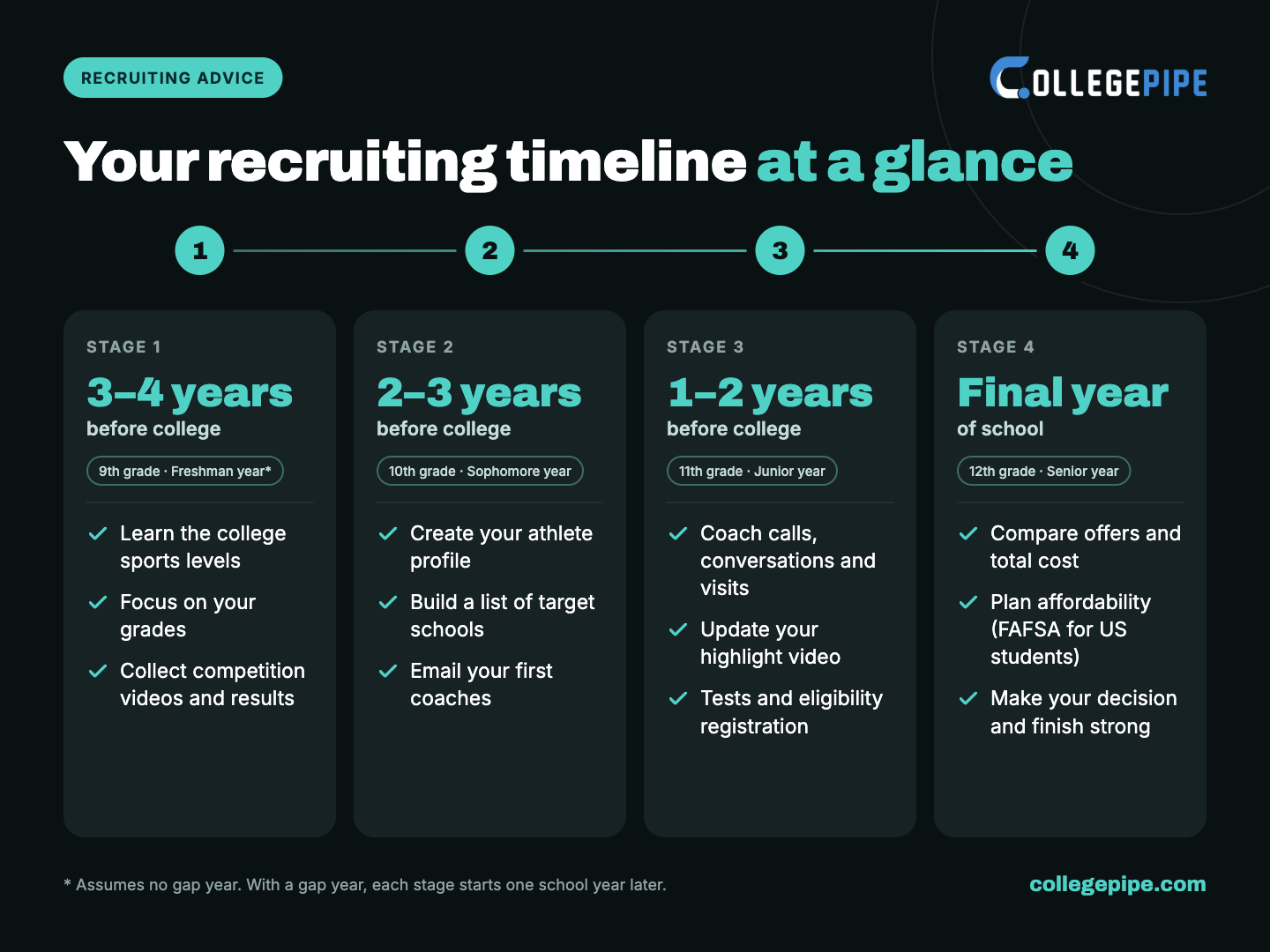
We count in years before college rather than school grades, so the timeline works wherever you go to school and whether or not you consider a gap year after finishing high school. The US grade is in brackets, assuming you go straight to college after school. Planning a gap year? Each stage then starts one school year later (more on that below).
Stage 1
3–4 years before college (US: 9th grade, freshman year)
This stage is about building a foundation, not contacting coaches.
Learn how college sports work. Get to know the levels (NCAA Division I, II and III, NAIA and junior college) and what each offers in competition, academics and scholarships.
Focus on your grades. They count from day one. Coaches check academics early, because an athlete who can’t get admitted can’t be recruited.
Start collecting competition videos and results. In team sports that means game footage. In sports like swimming, track or skiing, your times, scores and rankings matter just as much.
Stage 2
2–3 years before college (US: 10th grade, sophomore year)
Now you start making yourself visible.
Create your athlete profile. One place that shows coaches your video, stats, academics and contact details.
Build a first list of target schools. Aim wide, not just five dream schools. How wide depends on your sport: in larger sports with hundreds of college teams, your list can easily run past 50 programs across different levels. In smaller sports with fewer programs, include every one that fits you athletically and academically.
Send your first emails to coaches. You can contact coaches at any time. NCAA rules only limit when coaches may reach out to you, not the other way round.
Read this article: Writing Follow-Up Emails to Coaches.
Stage 3
1–2 years before college (US: 11th grade, junior year)
This is prime time. Most serious recruiting conversations happen in this window.
Expect calls, conversations and visits. Coaches who are interested will want to talk, and many will invite you to visit campus.
Update your highlight video. Lead with your best and most recent clips, and keep it short.
Take any required tests and register for eligibility. Depending on the schools on your list, that can mean the SAT or ACT and registration with the NCAA Eligibility Center or the NAIA Eligibility Center.
Stage 4:
Your final year (US: 12th grade, senior year)
The focus shifts from getting noticed to making a good decision.
Compare offers carefully. Look at the total cost after all aid, not just the percentage of the scholarship.
Plan for affordability. Few scholarships cover everything, so work out how the rest gets paid. US students should file the FAFSA (Free Application for Federal Student Aid) as soon as it opens in the fall of their final year, usually on October 1. It unlocks federal grants, loans and much of the need-based aid colleges award.
Look beyond the coach. Ask yourself whether you’d be happy at this school if sports were taken away tomorrow.
Finish strong academically. Final grades still need to meet admission and eligibility requirements.
Planning a gap year? It’s still possible
A gap year after school no longer has to cost you eligibility. In 2026, both NCAA Division I and Division II adopted an age-based eligibility model. Under it, athletes get five years of eligibility to play five seasons.
The key date is your 19th birthday. If you enroll in college no later than the academic year after you turn 19, you keep your full eligibility. A gap year to work, travel, improve your English or keep developing in your sport can fit comfortably within that.
NAIA and Division III have their own rules for now, so check them for the schools on your list. The NAIA rules in particular may change soon. For a quick overview of where things stand, see our Instagram post on the recruiting timeline. And with a gap year, simply shift every stage of the timeline above back by one school year.
Already in your final year? It’s not too late
Starting late makes recruiting harder, not impossible. Many programs fill their last roster spots late in the cycle, especially at the Division II, Division III, NAIA and junior college levels. Coaches also lose recruits to other schools and need replacements fast.
The difference is speed. If you’re starting now, do the Stage 1 to 3 steps within a few weeks:
Build your athlete profile and highlight video right away.
Make a broad list of schools, with a strong focus on programs that still recruit late.
Email coaches this week, not next month, and follow up after 10 to 14 days.
Sort out tests and eligibility registration in parallel, so paperwork doesn’t hold up an offer.
Step 1 at any stage: make it easy for coaches to find you
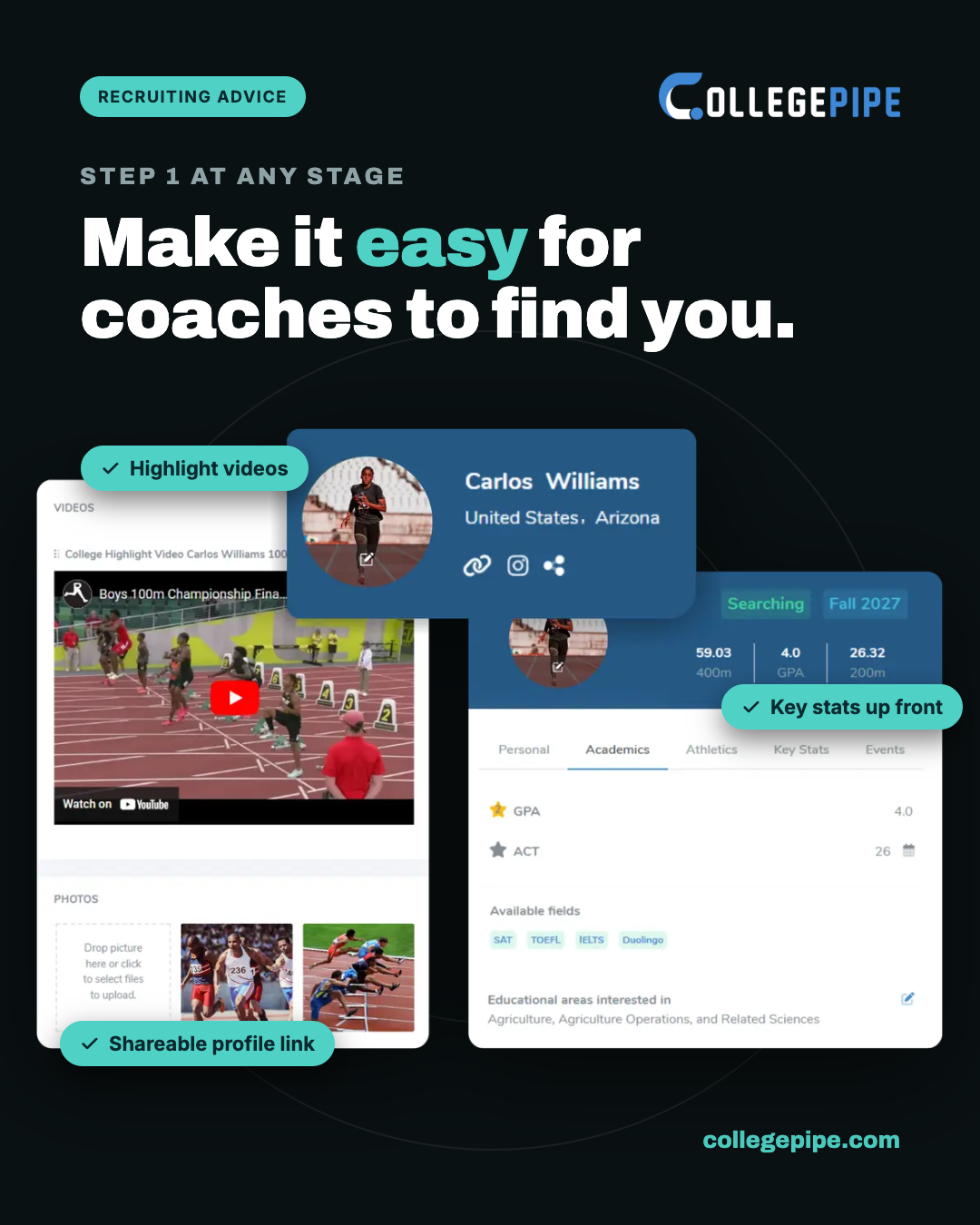
Whatever stage you’re in, coaches need one place to see who you are. They review hundreds of athletes and won’t dig through scattered emails, attachments and links.
A strong recruiting profile brings everything together:
Highlight videos coaches can play with one click
Key stats up front, both athletic and academic
Your status and start date, so coaches know when you’re available
A shareable link you can add to every email and message
On College Pipe, you can build exactly that kind of profile, search colleges by sport and level, and see which coaches have viewed your profile.
Frequently asked questions
Is it ever too early to contact a college coach?
You can email coaches at any age, but the timing affects the response. Before about two to three years out, focus on grades, development and video. Once you have a profile and recent results to share, reaching out makes much more sense.
Can college coaches contact my child directly?
Under NCAA rules, coaches can only start actively contacting athletes after a certain date, which varies by sport and division. NAIA has no such restrictions: its coaches may contact high school athletes at any age, all year round. Athletes and parents can reach out to coaches at any time.
Should parents email coaches on their child’s behalf?
It’s better when the athlete writes. Coaches want to see the athlete’s own interest and communication skills. Parents play a big role behind the scenes: planning, research, finances and keeping track of deadlines.
How long does the whole recruiting process take?
For most athletes, about two to three years from building a profile to signing with a school. Late starters can compress that to a few months, but with fewer options.
Does this timeline apply to international athletes too?
Yes. The stages are the same; only the grade labels differ. International athletes should plan extra time for English-proficiency tests such as TOEFL and for having their school records evaluated.
Start where you are
The best time to start recruiting was a year ago. The second-best time is today. Whether you’re four years out or already in your final year, the first step is the same: give coaches a clear, complete picture of who you are as an athlete and a student.
If you need more info, read on about this topic in our College Recruiting Guide.
Create your athlete profile on College Pipe and take the first step in your recruiting journey.


