NAIA Approves a Fifth Season of Competition: What Changes for Athletes & Coaches
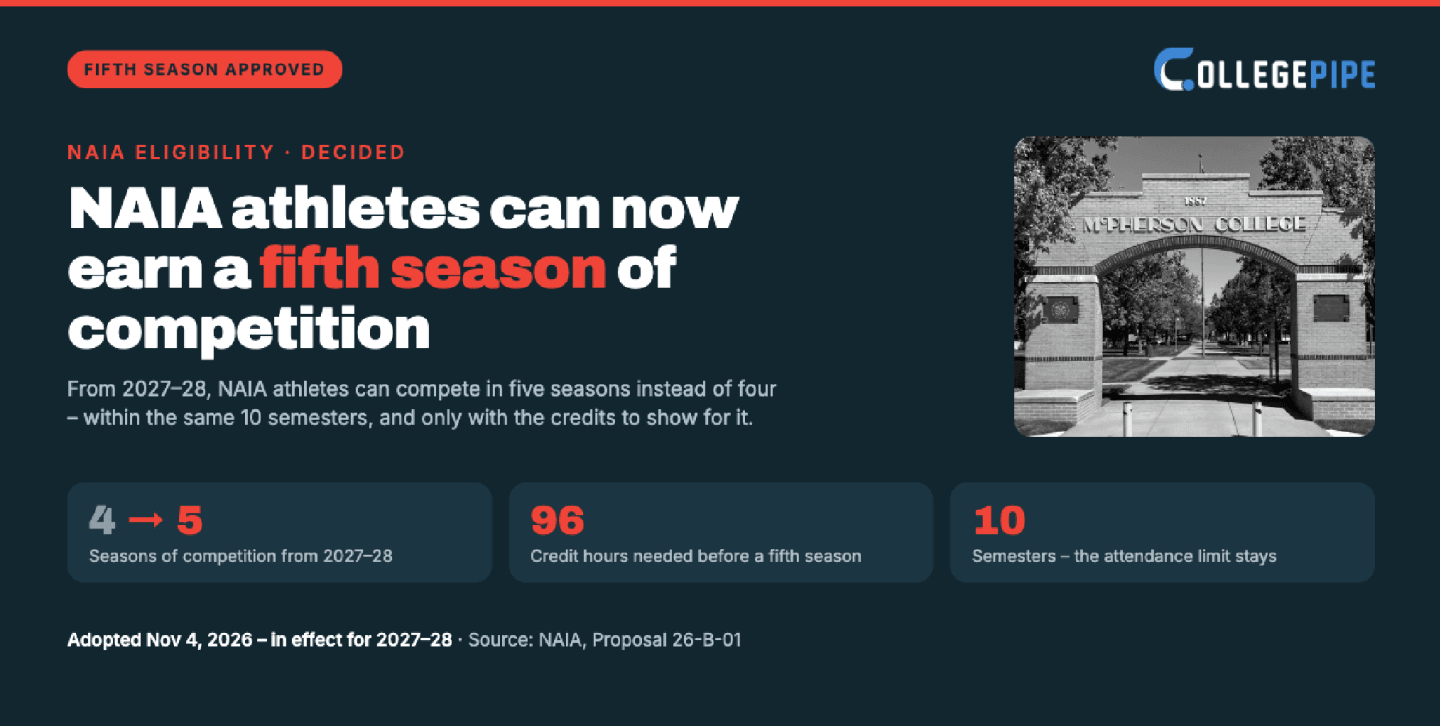
On November 4, 2026, NAIA member schools voted to give student-athletes a fifth season of competition (in short: SOC). A few weeks ago we already covered the proposal on our social media channel, such as Instagram. It's now official: from the 2027–28 academic year, NAIA athletes can compete in five seasons instead of four.
The change comes out of the NAIA's Path Forward Task Force and was brought forward by the NAIA Council of Presidents as Proposal 26-B-01.
NAIA President and CEO Jim Carr explained why:
"This opportunity recognizes the unique demands they face and allows more time to develop, compete, and prepare for life beyond college sports." – Jim Carr, NAIA President and CEO
What changes
Until 2026–27 | From 2027–28 | |
|---|---|---|
Seasons of competition (SOC) | 4 | 5 |
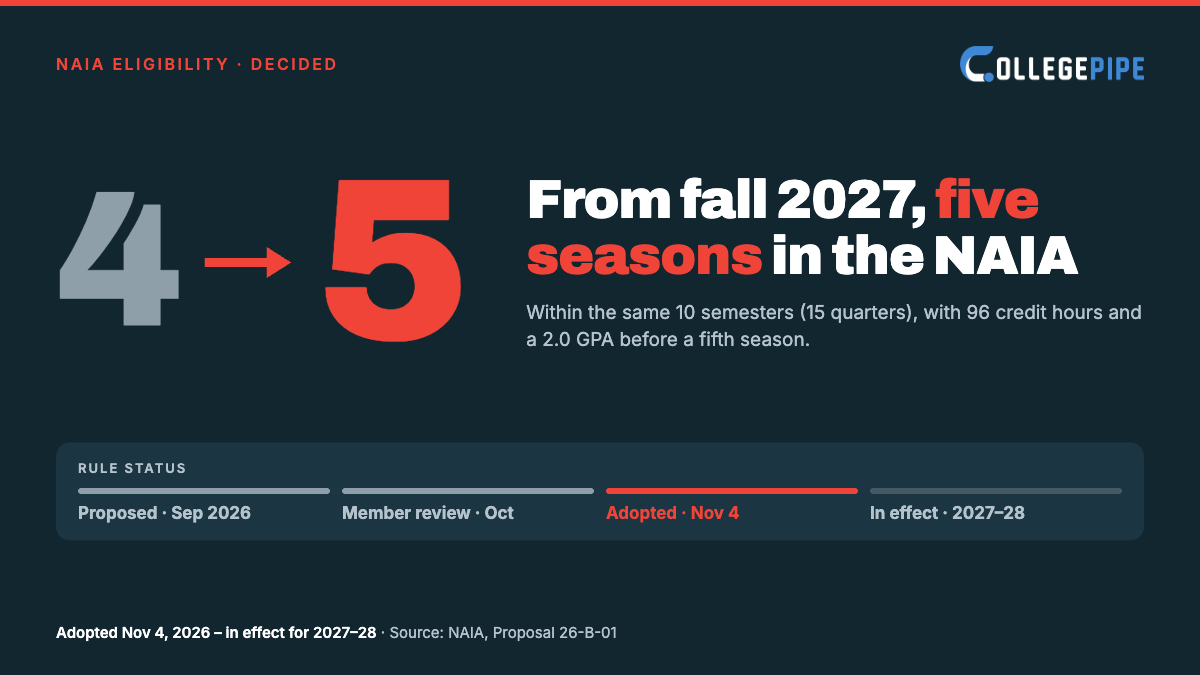
Attendance limit | 10 semesters / 15 quarters | 10 semesters / 15 quarters (unchanged) |
Credits before the last season | 72 semester / 108 quarter hours before a 4th season | 96 semester / 144 quarter hours before a 5th season |
20% participation exception | Yes | Removed |
Medical hardship exception | Yes | Removed |

Five seasons, same clock. Athletes get one more season but no more time: the limit of 10 semesters (15 quarters) of attendance stays. The terms don't have to be consecutive, so athletes can step away from college for a while or study part-time without burning through their semesters.
An academic gate for the fifth season. Before a fifth season, an athlete needs 96 semester (144 quarter) hours of institutional credit. Of those, 64 semester (96 quarter) hours have to come from general education courses or the athlete's major. The 2.0 cumulative GPA requirement still applies.
That's the point of the credit rule, as Council of Presidents Chair Karl Einolf put it:
"The most important part of the term 'student-athlete' is student." – Dr. Karl Einolf, Indiana Tech President and Chair of the NAIA Council of Presidents
No more partial seasons. The 20% participation exception and the medical hardship exception are removed. Taking part in even one contest counts as a full season.
Who qualifies
Current athletes: anyone who entered 2026–27 with at least one season and one term of attendance remaining. Seniors playing their fourth season in 2026–27 can come back for a fifth in 2027–28, if they have terms left and meet every other requirement. Anyone who uses up all 10 semesters (15 quarters) during 2026–27 can't return, even with seasons left.
Athletes who are already done: anyone who used four seasons or all 10 semesters (15 quarters) before 2026–27 doesn't get an extra year.
NCAA transfers: an athlete who played four seasons at an NCAA school can still play a fifth in the NAIA if they have terms left. The NAIA doesn't recognize the NCAA's five-year clock or age limits. An athlete whose NCAA clock has run out may still have NAIA eligibility, depending on prior seasons and terms.
When it starts
The legislation takes effect May 1, 2027, for eligibility decisions on NAIA competition from August 2027. The 2026–27 season still runs under the four-season rule.
What stays the same
Team financial-aid limits don't change. The Council of Presidents kept the current exception: athletes who appear in at most 20% of their sport's maximum number of contests and skip the postseason are still left out when the team's aid limit is calculated. Initial eligibility rules for incoming freshmen don't change either.
What it means for coaches and organizations
Rosters can hold more experienced players for longer, and a fifth-year athlete becomes a real recruiting option, including NCAA athletes whose clock has expired. Five seasons is the NAIA maximum, not a requirement: each school can set a stricter limit for its own athletes. With the 20% rule gone, even one match uses up a full season. Unlike an NCAA redshirt, sitting out a year while enrolled still uses two of the 10 semesters, so the fifth season, used in grad school or on a longer path to the degree, now does the job a redshirt year used to do.
What it means for athletes and families
If you play in the NAIA or plan to, five seasons is now realistic. That is only true if you stay on track academically. Plan your credits early. You need 96 hours before a fifth season, with most of them in "gen-ed" (general education) or your major. Already have your bachelor's degree? You can keep playing in grad school without the credit-hour rule. You must still have seasons and terms left. You must also meet the GPA requirement. Coming from the NCAA? Check your NAIA eligibility before you rule out another season.
Who Gets a Fifth NAIA Season?
4 Eligibility Scenarios
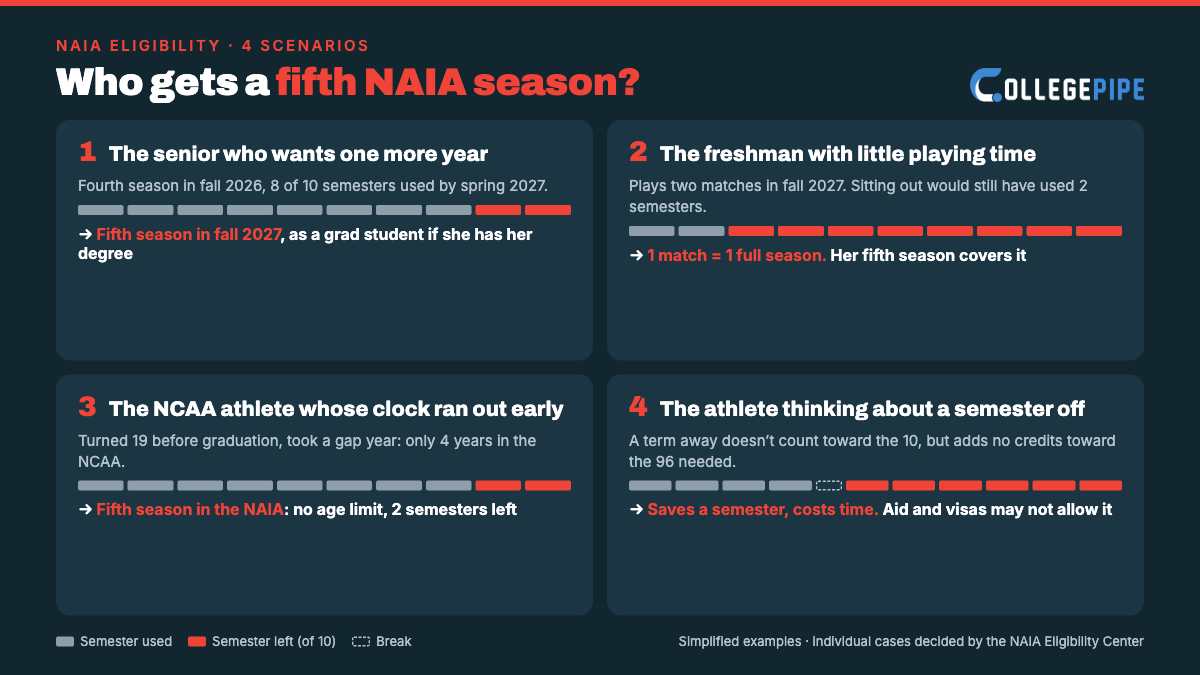
The rules are simple on paper, but the semester count makes them tricky in practice. Here is how we read them, using four typical situations.
The senior who wants one more year
A soccer player started college in fall 2023 and plays her fourth season in fall 2026. After spring 2027 she has used 8 of her 10 semesters. She entered 2026–27 with a season left, so she can come back in fall 2027 for a fifth season. If she has graduated by then, she plays as a graduate student: the credit-hour rule no longer applies, but she still needs a 2.0 GPA.
The freshman with little playing time
A freshman gets on the field in only two matches in fall 2027. Under the old 20% rule that season might have been saved. Now it counts as a full season. Sitting out instead would not have helped much: a year on the team still uses two of her 10 semesters, so she could never fit five seasons into the eight that are left. That’s what the fifth season is for: it replaces the old exceptions. She can use it in a graduate program or on a longer path to her degree.”
The NCAA athlete whose clock ran out early
Under the NCAA's new age-based model in Division I, the five-year clock starts with full-time college enrollment or the academic year after an athlete turns 19, whichever comes first. Take a high school senior who turns 19 before graduation and then takes a gap year before college. His NCAA clock starts a year before he ever enrolls, so he only gets four years in college sports. After four seasons in four years he is done in the NCAA. The NAIA ignores age limits, though, and counts semesters: he has used only 8 of 10. He can transfer and play a fifth season while enrolled in a graduate program, once the NAIA confirms his seasons and semesters.
The international athlete thinking about a break
Taking a semester off does not use up a term, so it can look like a way to stretch eligibility. For international athletes it rarely is. A student visa usually requires full-time enrollment, aid tends to stop during the break, and no credits are earned toward the 96 hours a fifth season needs. Talk to the school's compliance office before planning around a break.
These cases are simplified examples, which is our take on the situation, given the new rules. The NAIA Eligibility Center and each school's compliance office decide individual cases, and schools may set stricter limits than five seasons.
Looking for the right NAIA program? Four more schools join the NAIA in 2027–28: see who they are and where they compete. Find your fit on College Pipe - sign up today!
Sources: NAIA Path Forward Task Force, November 4, 2026 · NAIA Proposal 26-B-01, October 2026.


