Division I Men’s Soccer Stays a Fall Sport: What the Rescinded Two-Semester Plan Means for Recruits
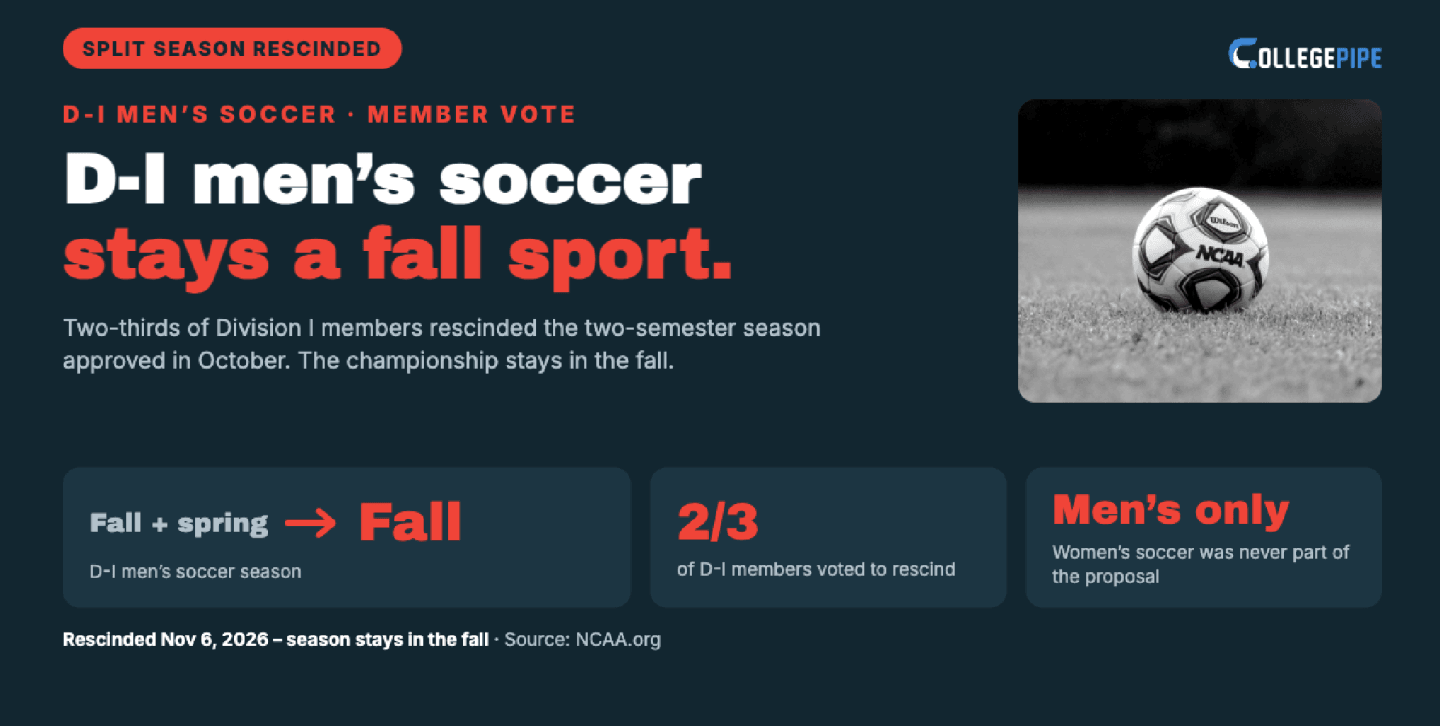
Division I Men’s Soccer stays a fall sport: the season and the championship will keep running in the fall. On November 6, 2026, enough Division I schools voted to rescind a rule change that would have spread the season over two semesters and moved the championship to the spring. For recruits, the takeaway is simple: the calendar you are planning around is the calendar you get. The bigger story is how close the plan came to passing, and why athletes should still get ready for a longer, more pro-style calendar. This is the topic of today's Friday Scholarship Guide.
What the vote means in plain terms
The new model was set to start in the 2027–28 academic year, and that is now off the table. Here is what stays the same, and what the plan would have changed:
The season and the championship stay in the fall. The NCAA put it in one sentence: “…Division I men’s soccer will continue to play its championship season in the fall.”
No fall and spring segments. The plan would have spread the regular season over both semesters, with the limit of 25 games per year staying the same.
The transfer window stays where it is. Under the rescinded plan, the notification-of-transfer window for Men’s Soccer would have opened only after the spring championship.
Women’s Soccer was never part of it. The Women’s Soccer Oversight Committee looked at the idea and decided not to propose a similar change.
Only Division I voted. The decision does not change anything in Division II, Division III, the NAIA or junior college soccer.
In short: same fall calendar, same recruiting rhythm.
From proposal to rescission: the timeline
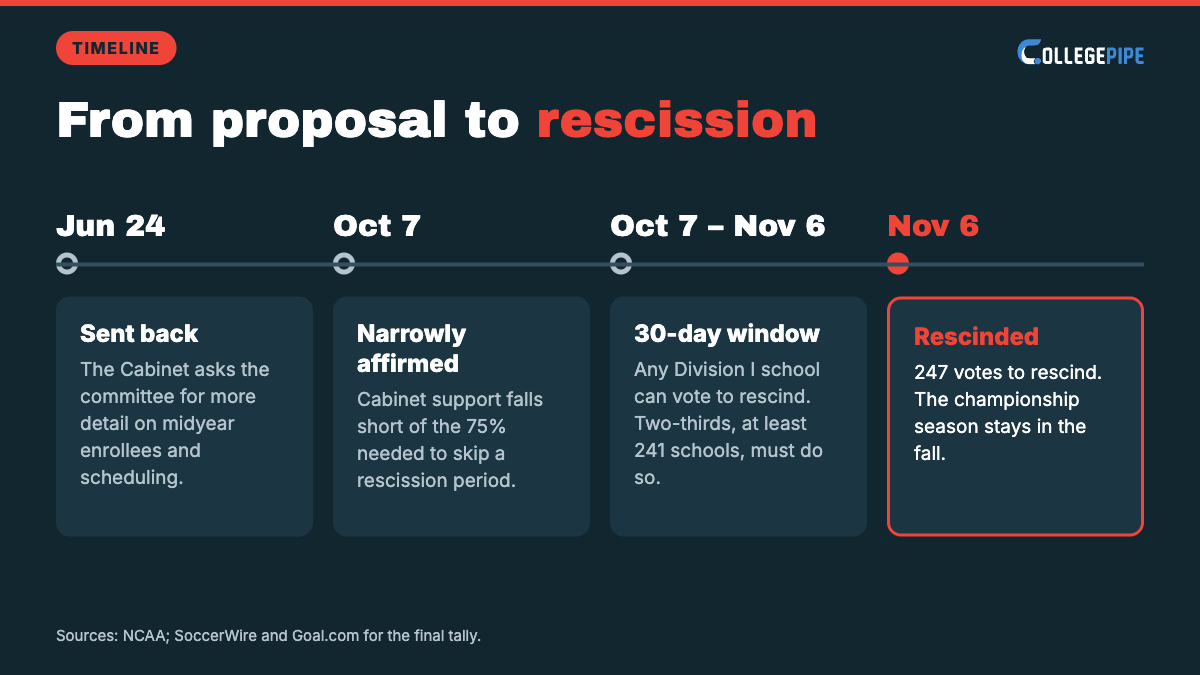
From the Cabinet’s first review to the final vote, the plan took just over four months, and the finish was tight. The key dates:
Date | What happened |
|---|---|
June 24, 2026 | The Division I Cabinet sent the proposal back to the Men’s Soccer Oversight Committee and asked for more detail. Open questions: how midyear enrollees would be affected and what scheduling problems schools would face (NCAA). |
October 7, 2026 | The Cabinet affirmed the revised plan, but with less than the 75% support needed to avoid a rescission period (NCAA). |
October 7 – November 6, 2026 | A 30-day rescission period. Any Division I school could vote to defeat the plan, and two-thirds of members, at least 241 schools, had to do so. |
November 6, 2026 | The plan was rescinded. SoccerWire and Goal.com both report a final tally of 247 votes to rescind. |
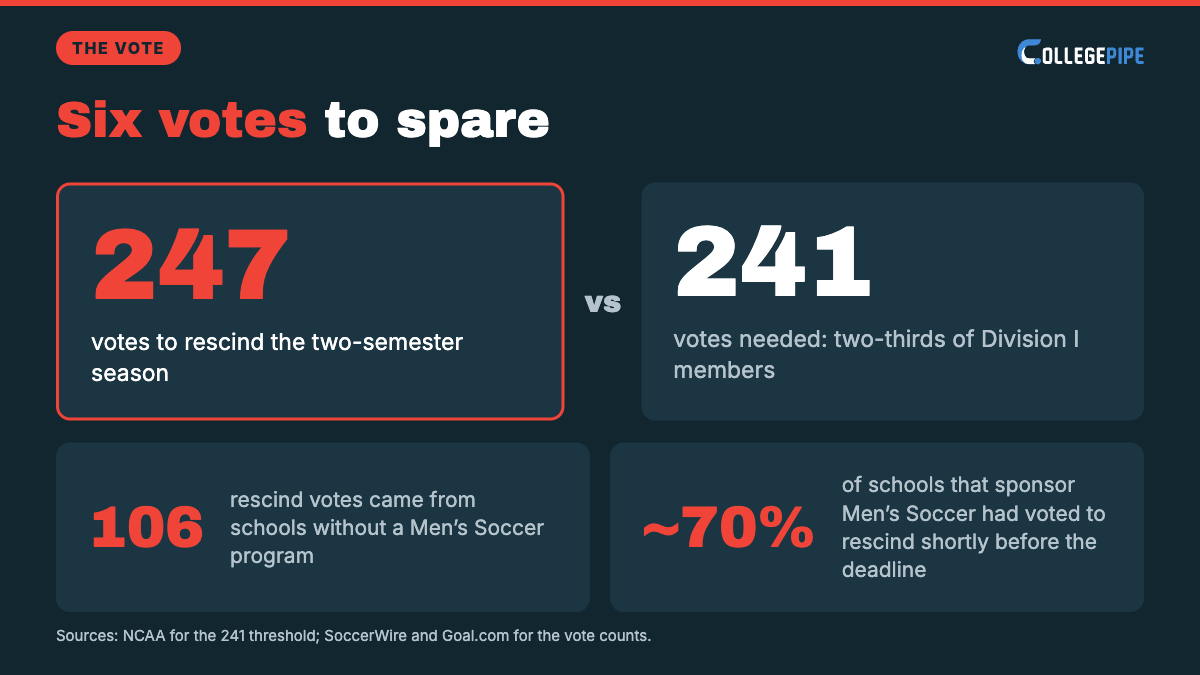
241 votes were needed and 247 came in, so the margin was just six votes. That is why both sides pushed hard until the very last minute.
Why Division I schools voted it down
The key to this result is the voting rule: every Division I school gets a vote on a rescission, whether or not it has a Men’s Soccer program (SoccerWire). That turned a soccer decision into a decision for the whole division, which is also part of the reason the outcome is so controversial.
Three things made the difference:
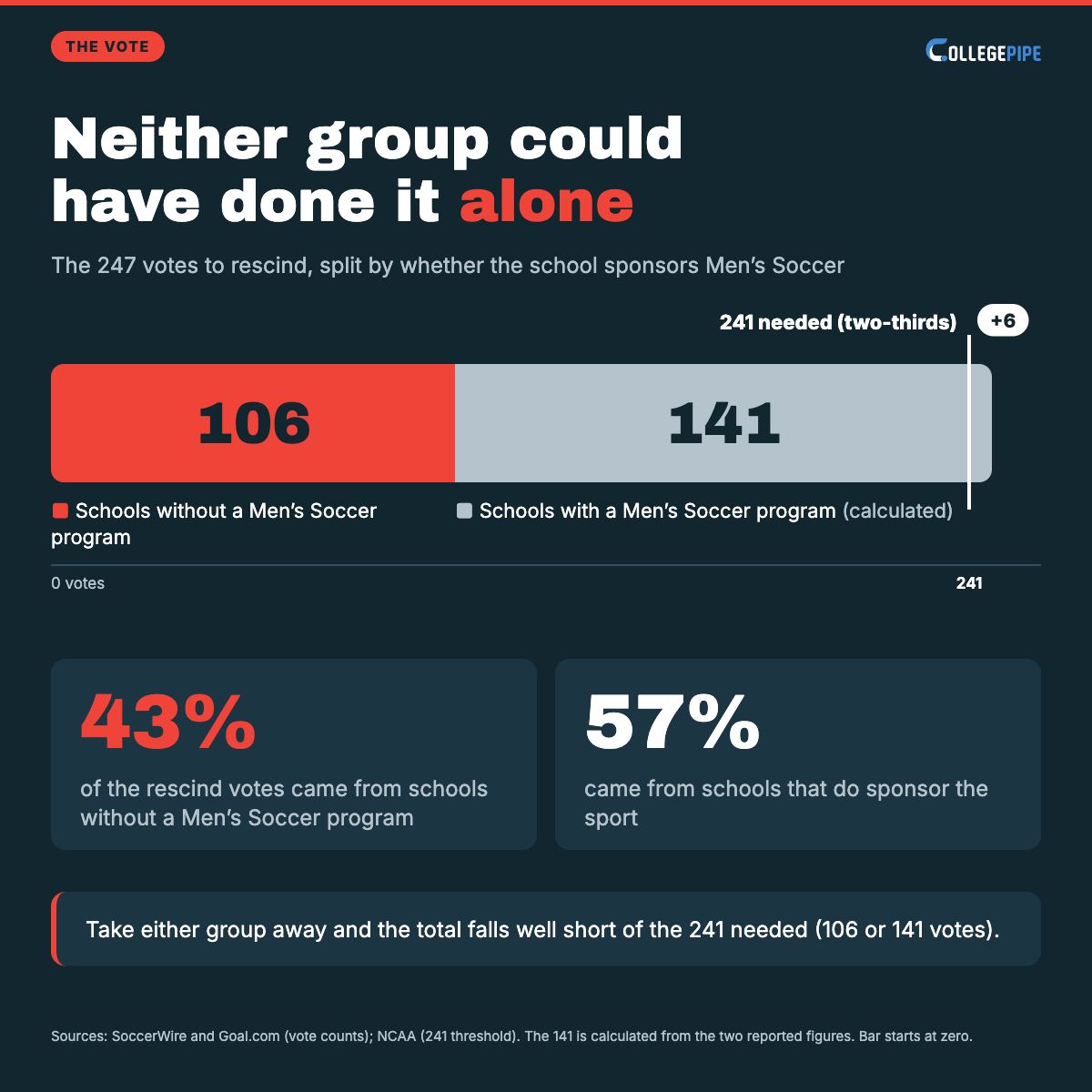
Schools without a program carried a large share. Goal.com counted 106 rescind votes from schools that do not sponsor Men’s Soccer. Maryland coach Sasho Cirovski, one of the plan’s leading supporters, pointed out that 41 of the last 50 votes against it came from schools without a varsity program.
Many soccer schools opposed it too. Shortly before the deadline, nearly 70 percent of the schools that do sponsor the sport had also voted to rescind, according to Goal.com. Earlier, the site had put the number of Division I Men’s Soccer programs at 213, with only around 80 firmly in favor, according to its sources.
Practical worries about shared resources. Florida Gulf Coast athletic director Brian Barrio, whose school sponsors Men’s Soccer, criticized the plan for not taking enough account of athletes in other sports who share facilities and support staff with the team.
One of the schools that voted to rescind put the same concern into words. Wofford Athletic Director Scott Kull said in a statement that real change needs the backing of many institutions and
“… a model that is sustainable for programs at every level of NCAA Division I” (Scott Kull via Goal.com).
That is the bigger picture behind this vote: Division I is not one uniform group, and changes in college sports do not land the same way at every school. Goal.com adds that colleges outside the Power Four rallied behind rescinding the plan.
Supporters, led by Cirovski and North Carolina’s Carlos Somoano, made a late push to get schools to withdraw their rescind votes, but it fell short. One note: the vote counts in this section come from media reports, not from an NCAA breakdown.
The case for a year-round season, and why the topic is not gone
Supporters have wanted a longer calendar for years. Their pitch, as the NCAA summarizes it: better talent development, more rest and recovery between matches and less weekday travel (NCAA). The root of it all is the compressed fall schedule.
Two developments outside the NCAA added momentum:
U.S. Soccer. Its NextGen College Soccer Committee, made up of 17 leaders from college athletics, professional soccer and business, published a white paper in October 2025 with recommendations to modernize college soccer (U.S. Soccer). For the men’s game, ESPN says the committee recommended a season spread over the full academic year.
MLS. The league will switch to a summer-to-spring calendar, with the 2027–28 regular season starting in mid-to-late July 2027 and the playoffs in May (MLS). The AP noted that the college proposal gained support after the MLS announcement (AP via La Nación).
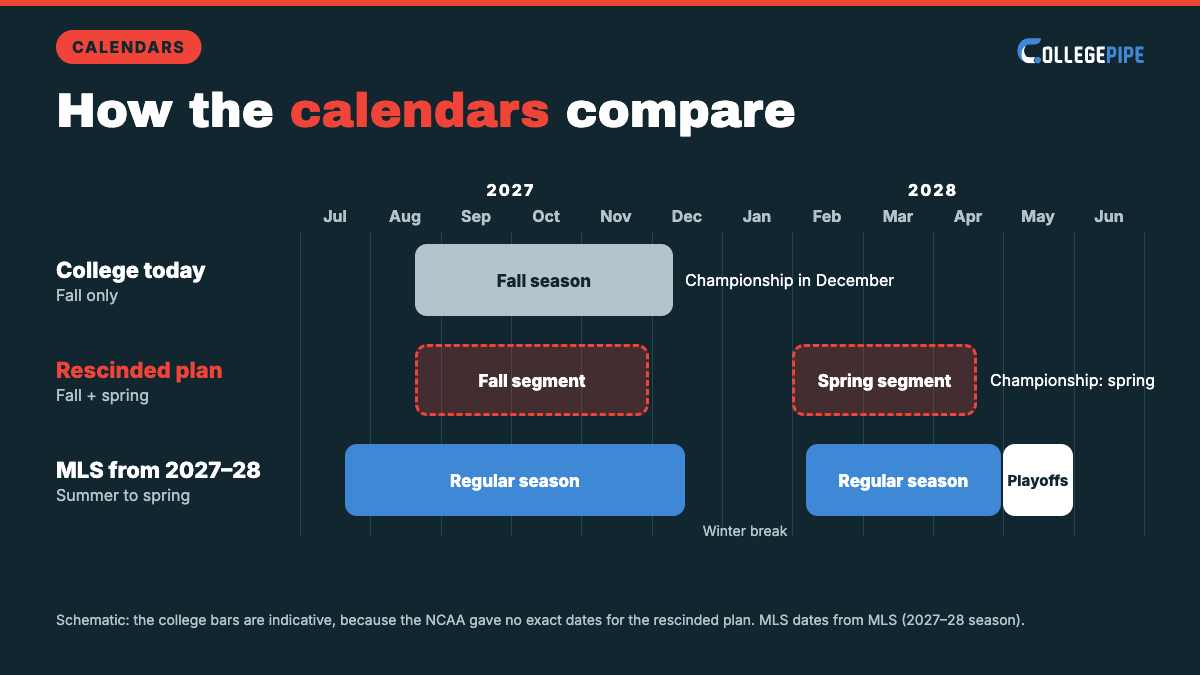
Put together, the two developments point the same way. Similar to European top leagues, the professional game in the U.S. is moving to a calendar that runs from summer into spring, and the people trying to modernize college soccer want the college season to look more like it. Coverage of the U.S. Soccer plan describes it as an effort to align the college game with global standards (Inside World Football). The rescinded plan was one route to that goal, and the goal has not gone away. For athletes who hope to play at the next level, that is a reason to get used to a longer, pro-style year now.
The vote ended this version of the plan, not the argument. Cirovski told Goal.com that the roughly 80 schools most committed to a two-semester model could form their own setup, potentially with U.S. Soccer’s input. That is an idea, not a decision, but it is a good sign the topic will come back.
What it means for athletes and families
The vote changes nothing about your timeline, which is good news if you are already deep into the process. Here are six things to do with that certainty:
Recruiting timelines are unaffected by this vote. That said, today’s recruiting timeline does look different from a few years ago, because the NCAA and the NAIA are both moving to five seasons of eligibility. In Division I, if you start college in fall 2027 or later, your clock starts at enrollment or the academic year after your 19th birthday, whichever comes first, so time spent waiting after you turn 19 can use up eligibility (NCAA announcement).
Keep planning around a fall season. Preseason starts in late summer, the season runs through the fall and the championship stays in December. If you are recruiting from outside the U.S., the August arrival you were planning for does not move.
Look beyond Division I. Division I was the only division voting here, and the other levels have their own rules and calendars. Compare them on the Divisions page and browse the college soccer programs to see where you fit.
Use the coach conversation. Ask each coach how the team uses the spring semester for training and development, and when they expect to finish their roster for your class. Our recruiting guide lists more questions to ask.
Prepare for a pro-style calendar. MLS is moving to a summer-to-spring season, and the push to bring college soccer closer to the pro game is still alive. This vote slowed that shift; it did not reverse the direction. So build habits for a longer competitive year: plan your fitness and recovery across the whole calendar.
Expect the topic to return. Calendar reform has strong backers, so check the NCAA tag on our blog for updates. Rule and program changes can also open doors, as we explain in 3 Reasons College Program Changes Can Be Your Ticket to a Scholarship.
Ready to put your list together? Create a free athlete profile and search the college database by division and sport.
What it means for soccer youth coaches and organizations
If you advise recruits, the fall calendar is now confirmed, so the schedules built around it stay valid: showcase calendars, ID camps, academy and club seasons, and the timing of commitments and signings.
Three practical points, one for each group:
Club teams & academies: keep balancing the format needs of the different divisions (current and possible future), while building year-round development plans that fit a pro-style calendar. Our Club Teams page explains what College Pipe can offer you and your soccer players when it comes to earning a spot on a college roster.
Recruiting services: rest assured that the 2027–28 calendar is not changing, but keep in mind that the discussion about a longer season continues. See how our systems back up your daily work with recruits, so you can streamline your processes and focus on what really matters: working with your players and college coaches. Learn more: Recruiting Services
College coaches: claim your free coach profile and keep your recruiting information current. Start on the College Coaches page.
Whatever your role, treat this as a pause, not an ending. Follow the NCAA tag on our blog.


