Why Your SAT Scores Matter

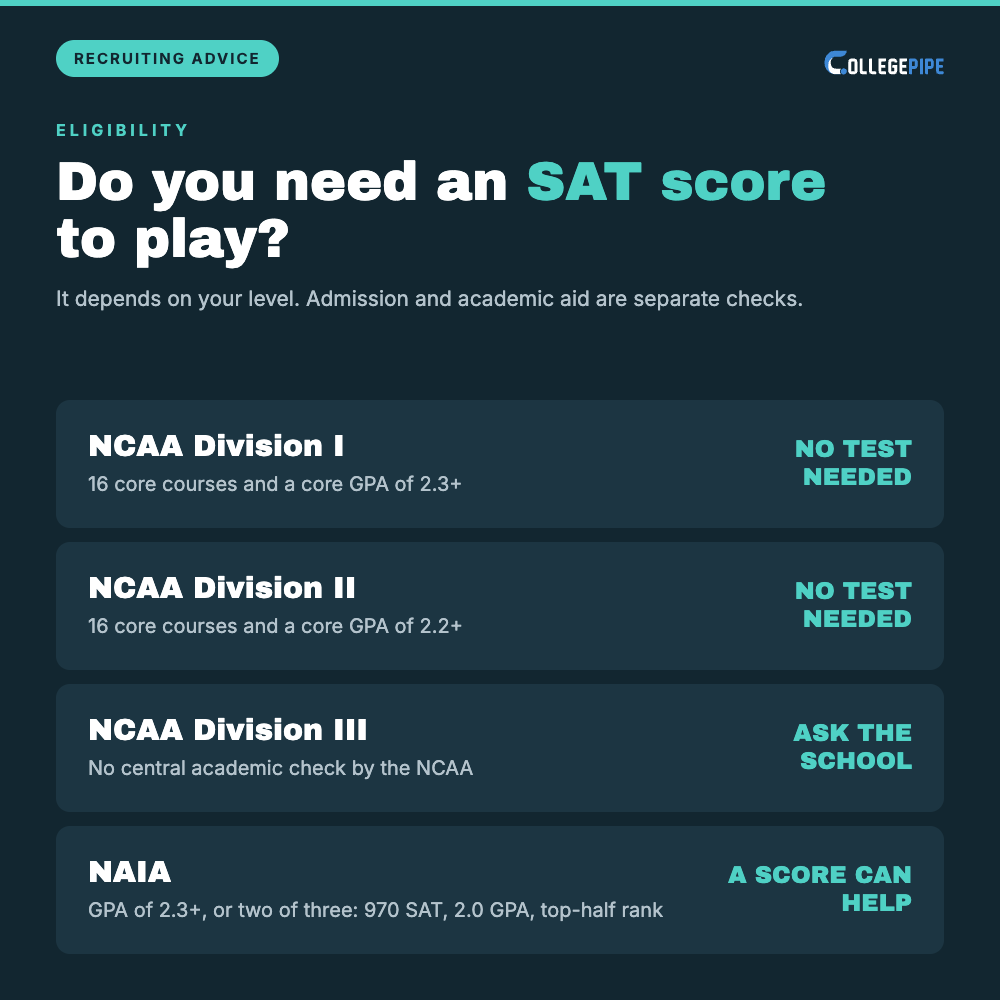
Both NCAA divisions dropped the test for good. Division I made the change first and Division II followed in January 2023. It applies to athletes who enroll full time from August 2023 onward, so you will find older articles that still say a score is required. Those are out of date.
The NAIA is the interesting case. If your GPA is 2.3 or higher and you have a class rank in the top 50%, you are eligible without a score. If it is lower, a test score can be one of the two items that gets you over the line, which makes the SAT a safety net. The NAIA's guide for college-bound athletes also says the score must come from one test date, and only the Reading and Writing and Math sections count.
Eligibility is only half of the story
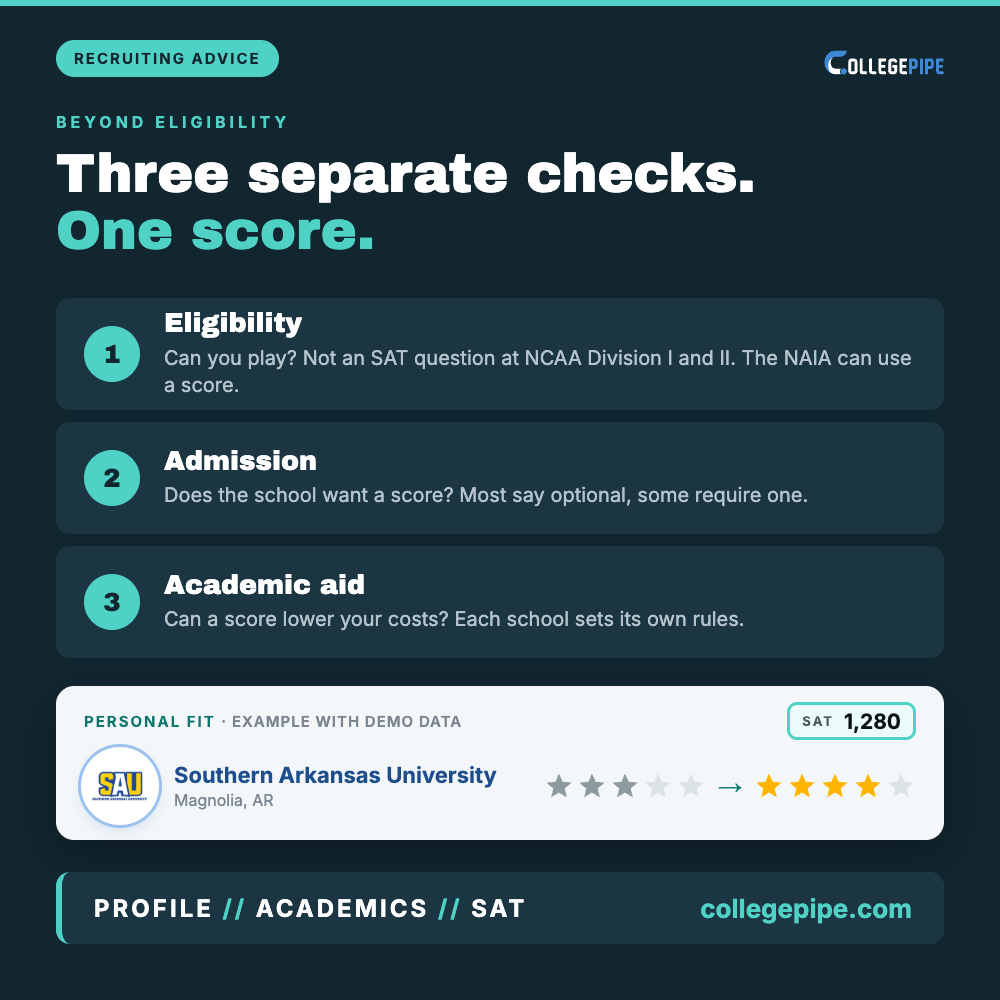
The NCAA and NAIA decide whether you may play. The school decides whether you get in. The admissions staff decide how much aid you qualify for. Those are three separate checks, and the second and third are where scores come back into the picture.
Most colleges let you apply without a score. Depending on who counts, only about 5 to 7 percent of schools require one: the College Investor cites 5 percent of Common App member colleges for 2025–26, and FairTest counts 161 of 2,247 colleges for 2026–27.
The group that requires scores is growing, albeit slowly, and it includes schools many athletes aim for. The College Investor's list, checked in October 2026, counts 72 colleges and systems that ask for a score in some form for fall 2027 entry. Among them:
six of the eight Ivy League schools, plus MIT, Stanford, Georgetown, Johns Hopkins, UT Austin, Ohio State and Auburn
all 12 public universities in Florida
systems in Alabama, Louisiana, North Carolina and Tennessee, where the requirement depends on your GPA
If one of these is on your list, no score means no application. Policies change every year, so check each school's admissions page before you decide.
Test-optional does not mean test-ignored
Even where a score is optional, many applicants send one. In 2025–26, 779,300 first-year Common App applicants reported a score and 748,028 did not, according to the same College Investor article.
There is a practical reason. A score is one of the few numbers that means the same thing at every high school. If your grades come from a school system that US admissions staff do not know well, a good SAT gives them something familiar to compare. That is our reading rather than a rule, but it is particularly true if you grew up outside the US.
The flip side matters too. If your score is below what a school usually sees, you can leave it out where it is optional. That is exactly why it helps to know each school's policy before you send anything.
Where the money is: academic aid
Myth buster: An athletic scholarship rarely covers everything, and many athletes combine it with academic aid. The NCAA's own scholarship page lists academic scholarships, awarded for grades, test scores or merit, as an option at all three divisions.
Two cases show why your score can matter:
Division III: schools cannot give athletic scholarships, so academic and merit aid is the main way to lower your costs.
Divisions I and II and NAIA: a strong academic profile can add to a partial athletic offer. Coaches like this, because an athlete who qualifies for academic money can need less athletic money, which leaves more for the rest of the roster.
Here's something a lot of athletes don't know and have a hard time believing:
A school offering zero athletic aid (NCAA D-III, NJCAA D-III, etc.) may actually turn out to offer a much better academic aid package than an NCAA D-I school will ever be able or willing to offer.
How much a score is worth depends on the school. Some schools tie award levels to bands of GPA and test score. Others, such as USC, say they never award merit aid by formula or cut-off. Check the scholarship page of every school on your list and ask coaches for their insights instead of assuming.
If you are an international athlete
Two things to watch:
Test-optional does not always apply to international applicants. Inside Higher Ed notes that some schools keep a score requirement for them or treat them differently.
Grade conversions from one educational system to the US are rarely straightforward and seldom work in your favor. A strong SAT score can balance out your application profile and often makes a big difference.
English proficiency is its own question. Many schools ask for TOEFL, IELTS or Duolingo, while some accept an SAT or ACT language score instead.
Ask each coach or admissions office which route they prefer before you book a test.
How your SAT works in College Pipe
Your score is one input to your Personal Fit in College Pipe. It counts only for universities that consider test scores, and it can move a school's fit by 0.5 to 1 star, up or down. Personal Fit already looks at both academic and athletic data, so a score you add sits next to your GPA, academic interests and sport profile.
To add it, open your profile, go to Academics and enter your SAT score. Then check which schools on your board change.
What to do next
Check every school's policy. Note which ones require a score, which make it optional and which publish merit aid rules.
College Pipe insight: you can add this information to a school's card on your Recruiting Board.Decide where a score helps. If a school requires it, you need one. If it is optional, send it only when it supports your case.
Send it to the right place. NCAA, NAIA and schools' admissions offices all want to receive test scores directly from College Board.
Add it to your profile. Update your SAT in College Pipe so your Personal Fit reflects it.
For registration dates, score release dates and score sending, see the College Board.
Already on College Pipe? Log in and add your score today. New to College Pipe? Explore how we help athletes find the right fit at collegepipe.com.


